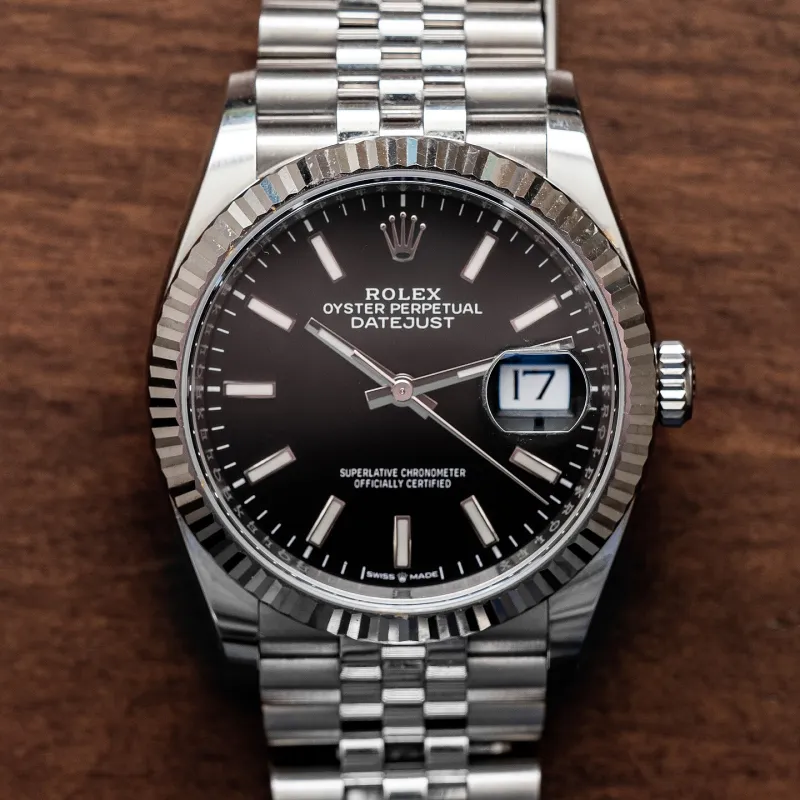
Story
It appeared in 1945, for Rolex's 40th anniversary: the pioneer of the waterproof, self-winding wristwatch whose date flips over by itself at midnight. The 'Cyclops' lens that magnifies the date was added in the 1950s.
With the ridged fluted bezel, the Jubilee bracelet and more, the combinations are many, and references split finely by material, dial and bezel.
Highlights
- A date at 3 o'clock with a magnifying lens
- A fluted bezel (in white gold and other metals)
- Jubilee or Oyster bracelet
Official videos


From the brand’s official YouTube channel. Playing a video connects to YouTube.
Which one to choose?
36mm or 41mm?
36mm (126234 and others) is the standard size since 1945 and slips easily under a cuff. 41mm (126334 and others) has more presence, and suits a larger wrist or a sportier way of wearing it.
Which bezel and bracelet combinations are there?
Two bezels: the ridged fluted (white gold) and the plain smooth (steel). Two bracelets: the five-link Jubilee and the three-link Oyster. At 36mm, the 126234 is fluted and the 126200 smooth; at 41mm, the 126334 and 126300. Fluted with Jubilee is the combination that looks most 'Datejust'.
16234, 116234, 126234: what is the difference?
All are 36mm with fluted bezels. The 16234 is the generation up to the 2000s, with a lighter bracelet; the 116234 got a more solid bracelet. The current 126234 moved to Cal. 3235 (about 70 hours of power reserve). The newer the generation, the higher the price.
What to check before you buy
- The last digit of the reference tells you the material combination (4 = steel with a white gold bezel, 3 = two-tone with yellow gold).